In 1892, as he lay in a Davos sanatorium sick with the tuberculosis that would eventually kill him three years later, Swiss scientist Friedrich Miescher made his second great contribution to science. His first had been the discovery in 1869 of a novel cellular substance that at the time he called ‘nuclein’, but which today is known by the more familiar name of deoxyribonucleic acid, or DNA, the material of heredity. Now, as he lay in the alpine resort, Miescher proposed how the immense variation in biological traits found in the living world might be manifest in the structure of a giant molecule. Part of his tragedy is that he could never have known that nuclein was the very molecule which did this…
Here is the letter written on 17th Dec 1892, in which Miescher first outlines his groundbreaking proposal, followed by my translation of it from the original German into English.
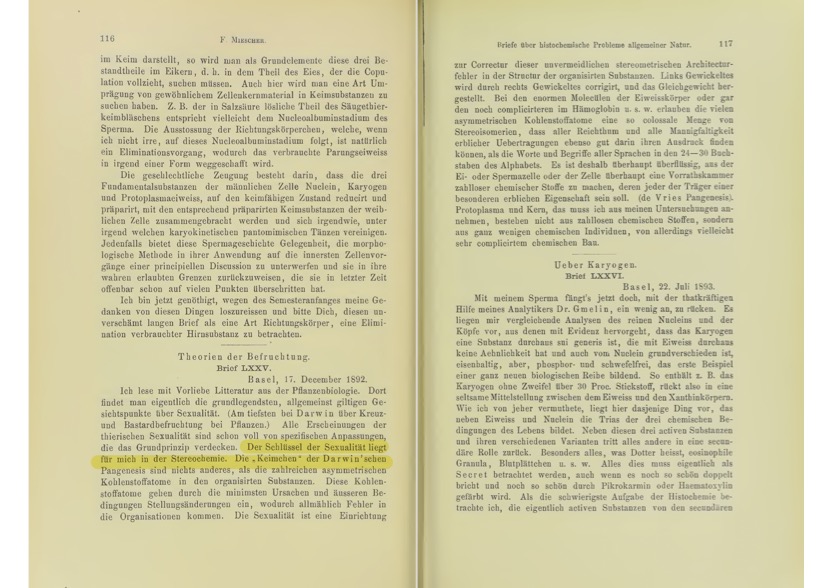
Translation: ‘I read botanical literature with fondness. There one finds the underlying, fundamentally general valid factors of sexuality. (Particularly in Darwin on the cross-fertilisation of plants). All instances of animal sexuality are full of specific adaptations that conceal the basic principle. The ‘gemmules’ of Darwin’s Pangenesis are nothing other than the countless asymmetric carbon atoms of complex substances. Through the slightest cause and external conditions, these carbon atoms undergo alterations in their arrangement which give rise to gradual errors in organisation. Sexuality is a mechanism to correct these unavoidable errors in the stereometric architecture in the structure of complex substances. Twisting to the left is corrected by twisting to the right and in this way the balance is established. In the enormous molecules of the proteins, or the even more complex ones such as haemoglobin etc [Note: haemoglobin is itself a protein, but in Miescher’s time must have been understood as belonging to a chemically distinct species], the many asymmetric carbon atoms allow for such a colossal variety of stereoisomers that the abundance and diversity of heritable transmissions find their expression therein as do the words and concepts of all languages in the 24-30 letters of the alphabet. It is therefore unnecessary for the egg, sperm or cells to be a repository of countless chemical substances, each of which carries a specific heritable trait. (de Vries Pangenesis). From my investigations I must assume that protoplasm and nuclei are not composed of countless chemical substances, but rather from only a few individual chemical entities which are perhaps very complex in their chemical make-up.’
Letter LXXV 17th December 1892 in ‘Die Histochemischen und Physiologischen Arbeiten von Friedrich Miescher’ (‘The Histochemical and Physiological Work of Friedrich Miescher’ compiled by Wilhelm His, 1897, Leipzig); pp. 116-117.