Make Mine a Pint…of Science

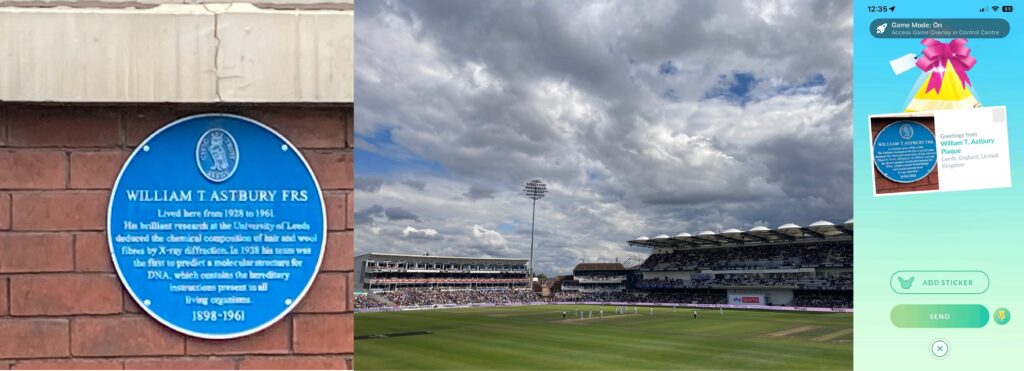
Long before Sir Alec Guinness was swinging a light-sabre and dispensing pseudo-Buddhist pearls of wisdom in ‘Star Wars’, he played idealistic scientist Sidney Stratton in the Ealing classic ‘The Man in the White Suit.’ But did Stratton have a real life counterpart in Leeds textile scientist William Astbury and his monkeynut coat? A big thanks to organisers of this year’s ‘Pint of Science’ – an international festival of science held in 500 cities across the world – for inviting me along on Wed 20th May at The Attic, Leeds to talk about this and the little known tale of how Yorkshire wool played a part in unravelling the DNA double-helix…@pintofscience #pint26

https://pintofscience.co.uk/event/unmasked-discovering-the-hidden-world-of-the-body-through-art

Rolling the Stone of Sisyphus…and Hacking the Heads Off the Hydra

As Friedrich Miescher found himself with less time to work on nuclein due to growing commitments, Classical mythology provided him with two powerful metaphors through which he could express his sense of frustration, futility, and being overwhelmed by the task before him. Both letters in which he expressed this are shown below with each being followed by my translation of the highlighted passage into English:

‘Since the middle of September, I have been entrenched in my laboratory without a single day’s interruption, often from 6 in the morning until late at night, in the hope of rolling the Stone of Sisyphus – which I call Salmo Salar [Note: this is the Linnaean name for the Atlantic salmon] -over the mountain.’

Letter LXIII 23rd Nov 1888 in ‘Die Histochemischen und Physiologischen Arbeiten von Friedrich Miescher’ (‘The Histochemical and Physiological Work of Friedrich Miescher’ compiled by Wilhelm His, 1897, Leipzig); p.106.

‘I need fifty hands, not just two. Year after year, I am preoccupied from early in the morning until midnight and there will be few of my colleagues who take less rest. But the task is like the Lernaean Hydra – for each head that is struck off, six more grow in its place.’

Letter LXIX 2nd Mar1891 in ‘Die Histochemischen und Physiologischen Arbeiten von Friedrich Miescher’ (‘The Histochemical and Physiological Work of Friedrich Miescher’ compiled by Wilhelm His, 1897, Leipzig); p.108.

‘You will be remembered as the ground-breaking researcher…’ ???? Or not?

As Friedrich Miescher lay sick in Davos with TB, his former mentor the distinguished physiologist Carl Ludwig offered him some words of consolation. The German original is shown below, followed by my translation of the highlighted text into English.

‘Ludwig always took part in following Miescher’s fortunes, he also visited him repeatedly in Switzerland and, as Miescher lay ill in Davos, he expressed his feelings in two heartfelt letters.

‘Truly,’ he wrote in one of the two letters, ‘Patience is easier to preach than practice, and I know from my own experience I know what it means to have to renounce work that is full of future potential and which one has come to love. As grievous as it may be for you to be sick, you have the comfort of having achieved everlasting accomplishments; you have made the centre, the core of all organic life accessible to chemical analysis; and however often the cell will be studied and examined during the centuries to come, the grateful descendants will remember you as the ground-breaking researcher.’

From ‘Die Histochemischen und Physiologischen Arbeiten von Friedrich Miescher’ (‘The Histochemical and Physiological Work of Friedrich Miescher’ compiled by Wilhelm His, 1897, Leipzig); p.12.

Sunken Treasure…

In the original letter shown below, followed by my translation into English of the highlighted passage, the tragedy of Friedrich Miescher is conveyed beautifully…

‘One of his former students compared him to a ship laden with priceless treasure that, just as it is returning to the harbour, sinks to the bottom of the sea.’

From ‘Die Histochemischen und Physiologischen Arbeiten von Friedrich Miescher’ (‘The Histochemical and Physiological Work of Friedrich Miescher’ compiled by Wilhelm His, 1897, Leipzig); p.2.