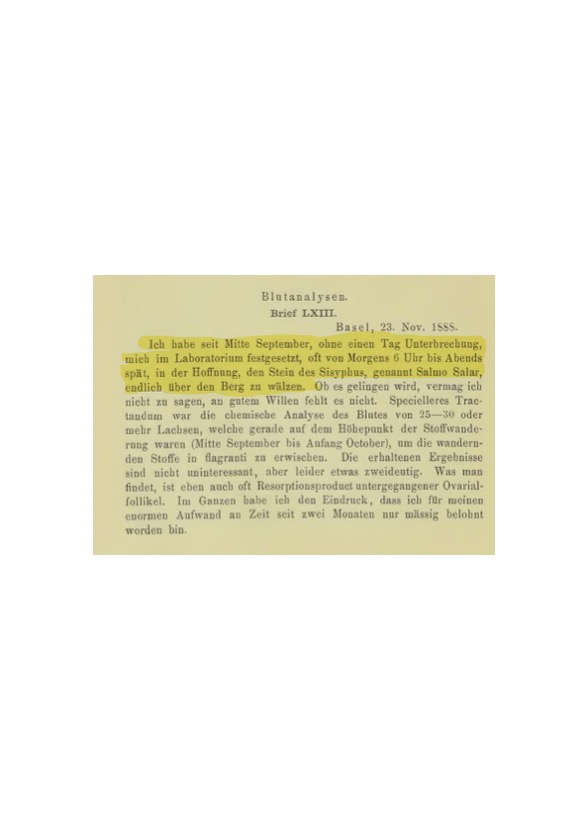
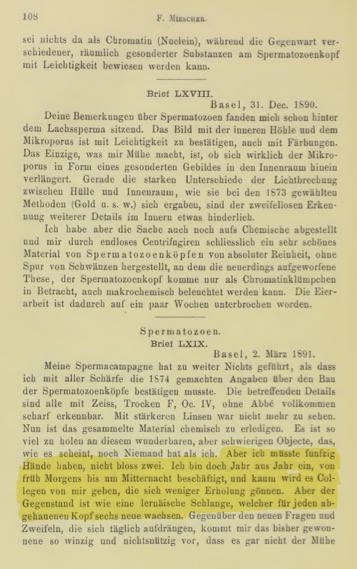
Despite having discovered what today we call DNA, the material of heredity, Friedrich Miescher went to his grave an unhappy man – weighed down by a sense of failure and missed opportunity – as this letter to his friend Ernst Böhm shows rather poignantly.
Miescher’s original letter is shown below, followed by my translation into English of the highlighted text:
‘I will never,’ he once wrote to Böhm [his friend, the German pharmacologist, Rudolf Böhm] know the happiness that belongs to the man who has lived up to their station in a harmonious way to the satisfaction of themselves and others, so my basic mood is the uncomfortable feeling of one who has lost a button from their braces.’ On another occasion he said, ‘For years I have to get used to the fact that, given the condition that my workload is four times as great as my capacity to do it, I must go to bed each night feeling like a schoolboy who has not completed his homework.’
Friedrich Miescher quoted in ‘Die Histochemischen und Physiologischen Arbeiten von Friedrich Miescher’ (‘The Histochemical and Physiological Work of Friedrich Miescher’ compiled by Wilhelm His, 1897, Leipzig); p.31.
Physicist and Nobel Laureate Erwin Schrödinger may have become something of a household name thanks to his eponymous thought experiment involving a quantum cat having provided many a plot line for the hit TV science sitcom ‘Big Bang Theory’. But another of Schrödinger’s contributions to science was a short book called ‘What is Life?’ Published in 1944 whilst Schrödinger was a political emigre in Dublin, it explored how a physicist might approach biology and in particular the molecular nature of heredity. In the book, Schrödinger proposed that a molecule, if sufficiently large, might be able to represent biological traits through variations in the physical arrangement of its atoms.
But – he wasn’t the first to do this. For nearly half a century before the publication of ‘What is Life?’, Swiss scientist Friedrich Miescher had proposed a very similar idea, as he lay sick with TB in a Davos sanatorium. Here’s the original letter by Miescher in which he outlined his idea, followed by my translation into English of the highlighted passage…
‘Continuity lies not just in form; it lies deeper in the chemical molecule. It lies in the constituent groups of atoms. In this sense I am, to the utmost extreme, a proponent of the chemical theory of heredity. But one must remember that the properties of the chemical bonds depend in their nature and intensity on the motion of atoms and in these easily degradable biological substances, the intramolecular motion of atoms in comparison with the inertia of the whole molecule is of particularly high intensity and independence, hence their degradability. If, as is easily possible, the protein molecule contains 40 asymmetric carbon atoms, then this would give 240 – in other words, roughly a billion isomers. And this is only one type of isomer in which isomers of nitrogen and unfulfilled valences are not taken into account.
The speculations of Weissmann etc, are plagued by half-chemical concepts which are partly unclear, and partly correspond to an outdated state of chemistry. If, as is easily possible, the protein molecule contains 40 asymmetric carbon atoms, then this would give 240, that is roughly a billion isomers. And this is only one type of isomer which does not take into account isomers of nitrogen or unfilled valences. My theory is more suitable than any other to account for the countless diversity proposed by the chemical theory of inheritance. If a pointed discussion of this question is required, all transitions – whether imperceptible or of the greatest difference, can be thought of in this way.’
Letter LXXVIII 13th October 1893 in ‘Die Histochemischen und Physiologischen Arbeiten von Friedrich Miescher’ (‘The Histochemical and Physiological Work of Friedrich Miescher’ compiled by Wilhelm His, 1897, Leipzig); pp. 122-123.
In 1892, as he lay in a Davos sanatorium sick with the tuberculosis that would eventually kill him three years later, Swiss scientist Friedrich Miescher made his second great contribution to science. His first had been the discovery in 1869 of a novel cellular substance that at the time he called ‘nuclein’, but which today is known by the more familiar name of deoxyribonucleic acid, or DNA, the material of heredity. Now, as he lay in the alpine resort, Miescher proposed how the immense variation in biological traits found in the living world might be manifest in the structure of a giant molecule. Part of his tragedy is that he could never have known that nuclein was the very molecule which did this…
Here is the letter written on 17th Dec 1892, in which Miescher first outlines his groundbreaking proposal, followed by my translation of it from the original German into English.
Translation: ‘I read botanical literature with fondness. There one finds the underlying, fundamentally general valid factors of sexuality. (Particularly in Darwin on the cross-fertilisation of plants). All instances of animal sexuality are full of specific adaptations that conceal the basic principle. The ‘gemmules’ of Darwin’s Pangenesis are nothing other than the countless asymmetric carbon atoms of complex substances. Through the slightest cause and external conditions, these carbon atoms undergo alterations in their arrangement which give rise to gradual errors in organisation. Sexuality is a mechanism to correct these unavoidable errors in the stereometric architecture in the structure of complex substances. Twisting to the left is corrected by twisting to the right and in this way the balance is established. In the enormous molecules of the proteins, or the even more complex ones such as haemoglobin etc [Note: haemoglobin is itself a protein, but in Miescher’s time must have been understood as belonging to a chemically distinct species], the many asymmetric carbon atoms allow for such a colossal variety of stereoisomers that the abundance and diversity of heritable transmissions find their expression therein as do the words and concepts of all languages in the 24-30 letters of the alphabet. It is therefore unnecessary for the egg, sperm or cells to be a repository of countless chemical substances, each of which carries a specific heritable trait. (de Vries Pangenesis). From my investigations I must assume that protoplasm and nuclei are not composed of countless chemical substances, but rather from only a few individual chemical entities which are perhaps very complex in their chemical make-up.’
Letter LXXV 17th December 1892 in ‘Die Histochemischen und Physiologischen Arbeiten von Friedrich Miescher’ (‘The Histochemical and Physiological Work of Friedrich Miescher’ compiled by Wilhelm His, 1897, Leipzig); pp. 116-117.
This must surely be a first! – a DNA-themed pub crawl! In the space of a week (and all in the interests of the history of science) I’ve visited what must be the only 2 pubs in the UK to have a link with the story of the famous double-helix and its discovery.
Sign outside ‘The Eagle’ pub in Cambridge centre
First, ‘The Eagle’ in Cambridge where James Watson and Francis Crick used to hang out (and Crick also shared drinks with Rosalind Franklin when she visited)…
…and now, ‘The Golden Beam’ in Headingley, Leeds where this wonderful portrait of scientist Florence Bell shown below now hangs on the wall alongside other distinguished former residents of the area such as playwright Alan Bennett, author J.R.R. Tolkien, and a fair few cricketing legends too.
It was in 1938, whilst working in the lab of William Astbury at Leeds, Bell first showed that X-ray methods could be used to reveal the regular structure of DNA – paving the way for the later work of the more famous Rosalind Franklin.
Print of portrait of scientist Florence Bell (1913-2000) by artist Kristina Keller. Print kindly donated by Howard Hughes Medical Institute, Janelia campus
A big thanks to Sarah Moorehead and Ron Vale of Howard Hughes Medical Institute in the US where the original (based on a portrait kindly provided by Bell’s son Chris Sawyer and made by member of staff and artist Kristina Keller as a mosaic of tiny images from scientific papers) hangs outside the cafe on their Janelia campus for kindly sending me this print and to Golden Beam manager Chris for taking up my suggestion of hanging it on the wall of the pub so that Bell can be commemorated in the city where she did her groundbreaking work. Rosalind Franklin has a 50p commemorative coin, a hit West End play, and a Mars Rover (quite rightly!) named in her honour, but it’s great to see Bell at the Beam!